

Getting To Sette Cama Eco Camp
If anything indicated that Gabon is far from Africa’s well-worn tourist trails, it was the boarding queue for Libreville at Charles de Gaulle Airport.
Looking around, most passengers were on their way home, rather than setting off for holidays. The few, obvious foreigners interspersed in the crowd stuck out in their single digits. Most held papers proving Gabonese residency or wore the vestments of faith.
Hours later, our arrival in Libreville suited Gabon’s climactic temperament too well. Slow, somewhat moving at a pace that eventually followed the officials’ ambivalent directions, and never hurried along. And why bother? We’d already arrived.


Libreville is the sort of capital where you can share a cold beer with friends at one of the city’s beach bars – only to watch a sea turtle lay a clutch of eggs in front of you hours later. Come 8 am, and the contrast of a city in gridlock jolts you, as Libreville’s residents all queue along the roads at once in search of their desks.
Departing Libreville for Gamba on a domestic charter, the cloud cover quickly steals our view. For a country covered in 80% rainforest, the clouds can afford to linger, anchored in place by a network of tangled canopies below.
An hour or so later, pockets of rainforest and lagoon begin to peek through, and it’s time to touch down at an airstrip built to serve Gabon’s oil industry, rather than bending to tourism. A small lean-to sits opposite the arrivals hall, which is meant to be walked around, rather than through.
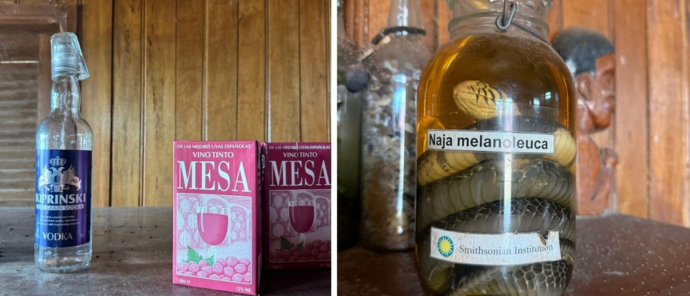
Not quite an exercise in ‘build it and they will come’ - refreshments are offered for sale via a shot glass perched atop a lone vodka bottle, sharing its shelf with a forest cobra stuffed into a jar. A label for the Smithsonian Institute suggests the jar might be on loan (intentionally or not) from the small Smithsonian museum, understood to be collecting dust under lock and key in town.
From Gamba, it’s a short ride to the edge of Ndogo Lagoon. Gamba town, once built by Shell to boom along to the rhythm of oil, is sleepy and sedate.
Our arrival is not intended or well-timed to bear witness to its heyday. As we traverse the through-road with its scattered buildings and green backdrop, the rainforest maintains its main-character energy. We pass small farms growing clustered crops with elephant-proof fences built from repurposed oil pipelines. Quite effective, I'm told, at warding off would-be crop raiders.
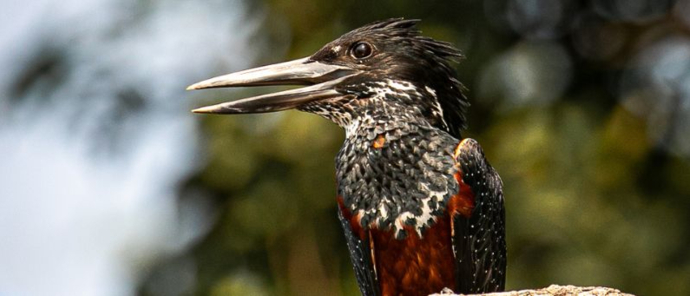
As we climb into boats for the hour’s journey into camp, the unmistakable trill of a Woodland kingfisher rings out from the trees. In Southern Africa, this call would mark the start of summer and the rainy season. In Gabon, bound by the equator, all it marks is another day on tropical Africa's doorstep.
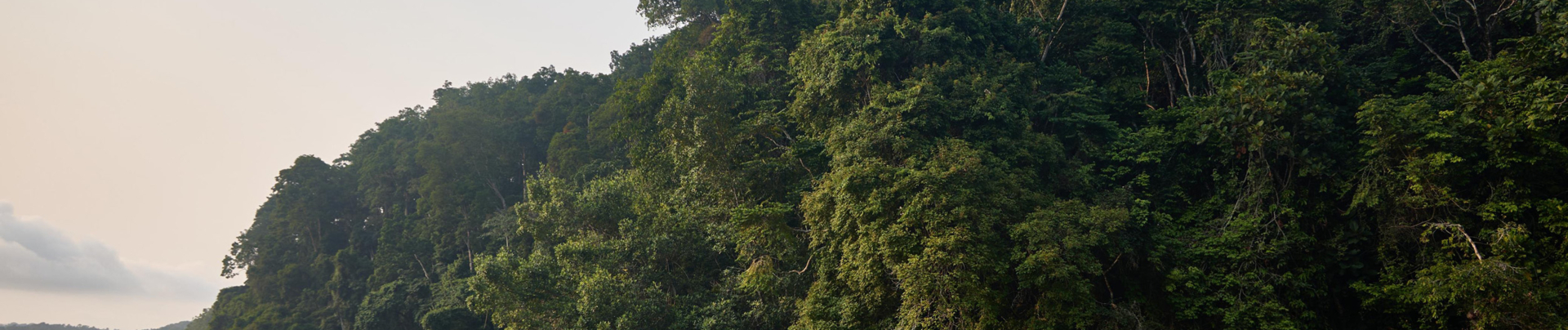
There’s a paradox about being on a boat in the Ndogo Lagoon. We’re farther from the rainforest than on foot beneath the canopy, yet better able to see into it. Palm nut vultures make constant cameos overhead as our boat journeys across the water, and smaller figures of Rosy bee-eaters and kingfishers adorn the branches that line our route.
An hour later, pulling into Machaba’s future site for Sette Cama Eco Camp, we find ourselves arrived. Whatever at this intersection of rainforest, lagoon and coastline – the idea of arriving might even mean.
Exploring the Rainforest


I’ve arrived at the site of the future Sette Cama Eco Camp to explore what Loango National Park has to offer and, with the team, decide how we might guide explorations of Sette Cama’s contrasting landscapes without altering the face of them.
While people have visited Sette Cama for years here and there, and the team we’re working with have been guiding guests in Loango since the 90s, the focus has typically centered on catching tarpon, threadfin and snapper, rather than delving deep into the forest. As one of our guides, Ed, explained… “You can fly over this forest, see a flat canopy and assume that’s what it looks like beneath. But when you get in there, there are valleys and hills and all sorts of secrets. You can know something is there and miss it by just a few metres. The rainforest doesn’t easily share what she knows.”
At Sette Cama, this marked our first challenge. Deciding how to create and set expectations for immersive wilderness explorations when so many people associate Africa with the easy ambivalence of habituated savannahs in the continent’s east and south.
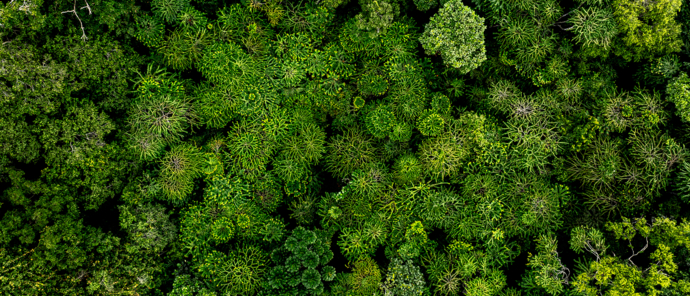
While Sette Cama and Loango National Park host a wealth of biodiversity, their landscapes envelop you in 3D. The dense forest canopy is Sette Cama's true super-highway, providing ease of movement for primates who have little reason to traverse the ground habitually, except when motivated by food or curiosity. To build roads or otherwise attempt to open up this habitat would not only destroy it but also ruin what’s so special about meeting it in the first place.
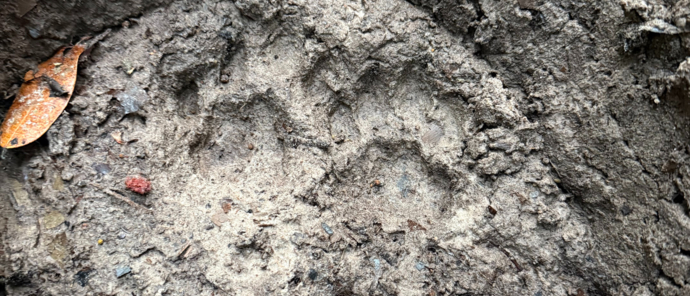
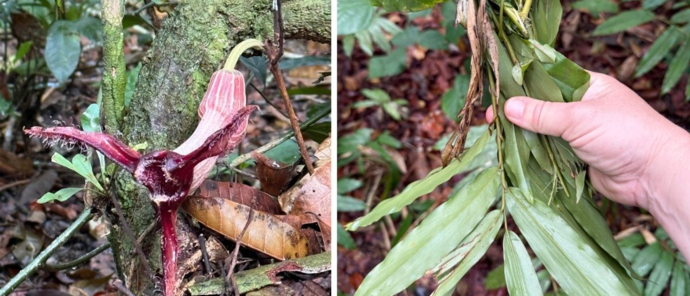
The trick to engaging with such a multi-faceted and wild environment had to be about using more than just our eyes and learning to read ALL the cues around us. Not just by tracing out tracks, but by interpreting distant shrieks, whether bird or primate. We’d need to pay attention to the sharp tang of over-ripe fruit crushed underfoot, and look for the distinctive foraging marks of red river hogs.
To look up to where the canopy blocked out a little too much light, revealing the curling remnants of a chimpanzee or gorilla’s nest hanging from branches above.
In the forest, with all senses engaged, our footsteps quickly become too loud. We begin to raise eyebrows at each other to enquire about who has sent out a distant call, and our tracker Jean-Alain brushes his cheek with a finger to indicate grey-cheeked mangabey. With a basic set of hand signals, we’ve removed not just the disruption that speech creates in observing our environment, but the barriers of language between French-speaking Jean-Alain and English-speaking us.
Of course, we aren’t the only ones with our ears sharpening in this environment. The chimps that reside here are wild, unhabituated and far from ambivalent. For every time we pick up on their chatter and shaking of branches, they no doubt also hear our footsteps and whispered words as we scramble to locate them. Instead of racing forward and creating more noise, we unroll the hammocks stashed in our daypacks – hang them from the trees, pour cups of coffee and hang out (quite literally) for an exercise in echolocation.
We don't have to wait long before we begin to hear two different family groups of chimpanzees chattering amongst themselves as they move through the canopy. Over the next 45 minutes, we track their movements and the speed at which they move in bursts of chatter and shaken branches.
Heading towards the end of a forest trail, the sound of waves crashing in the distance breaks the spell of just how deep inland we are – reminded that beyond our path through the trees, we’re connected to remote coastline – the forest creating cover for wildlife as it moves between these ecosystems.
Sette Cama's Coastline
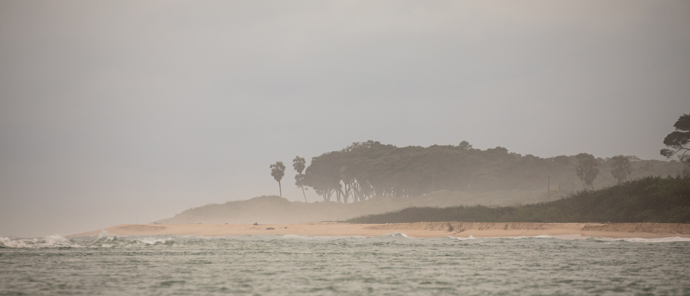
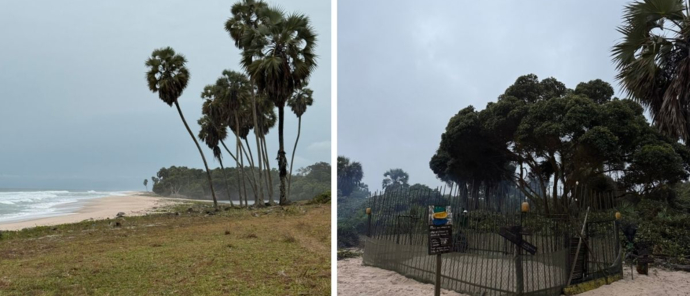
Out along the shoreline of Sette Cama, it’s easy to forget that a hundred metres to the east and we'd be immersed in an ocean of trees instead. The track north from Ndogo Lagoon’s estuary mouth is fringed by palms and milkwood trees, with the easy waypoint of the Atlantic to the left, sand underfoot and rainforest to the right.
An hour and a half’s walk from the estuary mouth, and we reach Point Milongo – a raised ledge of coastline sheltered by milkwood trees, which, when fruiting, pull in thousands of grey parrots to feed, their distinctive scarlet tail feathers flashing between branches. Looking out to sea, the occasional splash of water indicates humpback whales moving far offshore, and we take the chance to squint through binoculars for the next sign of life.
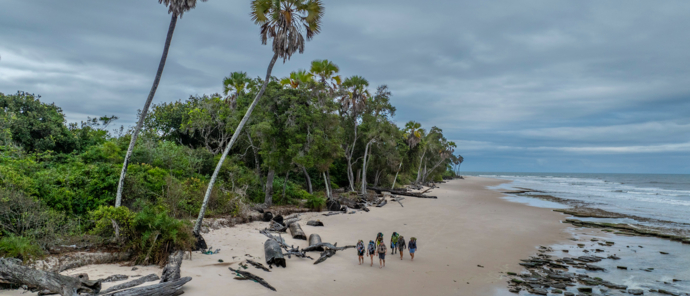
This, we decide, is the perfect place to set up a back-to-basics sleep-out. To swim in the Atlantic, set up a campfire and bed down under the trees. From here it’s the perfect base to embark on a pre-dawn excursion, another hour’s walk north the next morning – in search of Loango's surfing hippos.
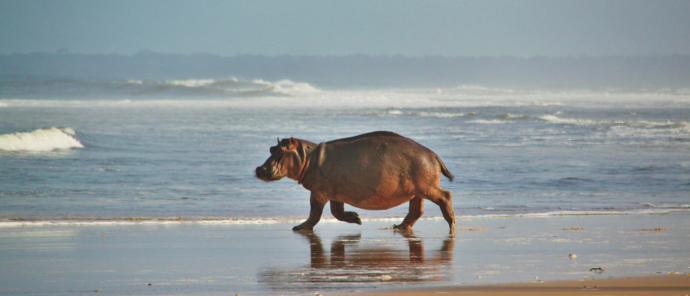
From our elevated viewpoint at Point Milongo, we can easily see north, towards the sandy shores and grass-covered coastline that connects Loango’s beach to a series of lagoons. This little stretch of coast pulls in forest buffaloes to graze on grasses, red river hogs that hunt ghost crabs on the sand, and lagoons that motivate the pre-dawn commute of hippos who take the surf like a subway - shuffling south in the ocean’s swell each morning from nocturnal feeding grounds.
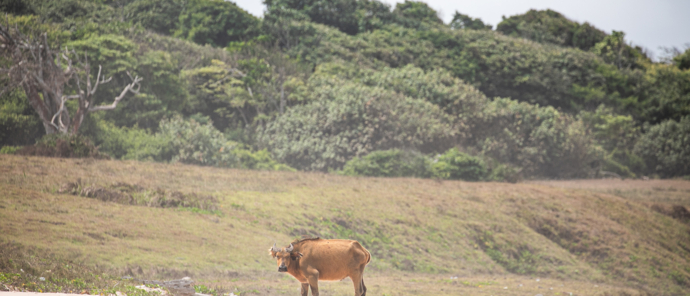
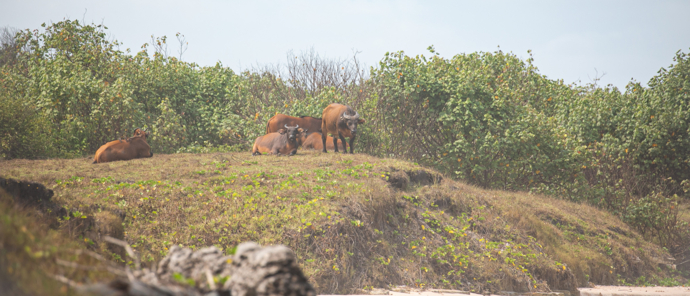
The algae-covered rocks in the shallows provide an easy buffet for juvenile sea turtles that glide beneath the breakers as we move towards the lagoons to stake out a spot under tall palms. An early, but extended siesta in our hammocks, later, we take a final look at the waves before breaking ranks with the hippos and moving into the rainforest in search of primates.
Ndogo Lagoon Explorations
If the canopy is the super-highway of the rain forest, then Ndogo Lagoon’s estuary is Sette Cama’s bypass. With water connecting everything here, from coastal trails to back bays and coastline, everything except the resident great apes eventually crosses this lagoon - the only uncertainty being when, not if.
During the wet season, the lagoon’s estuary turns tea-coloured with tannins, and it’s not unusual to see forest elephants swimming across to diversify their diets with fresh coastal growth. From the coastal scrub, if we pay close attention, we’re bound to spot a forest sitatunga’s head poking from the growth, or catch the tell-tale bounce of a branch spring-boarding beneath a red-capped mangabey.
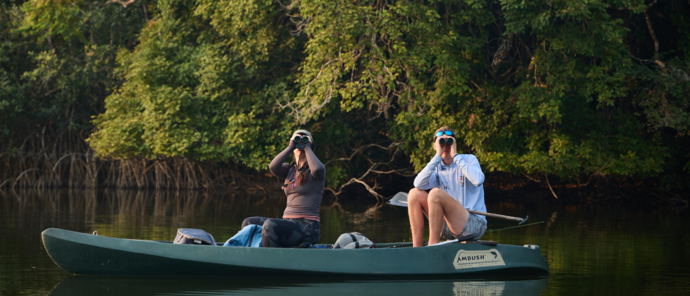
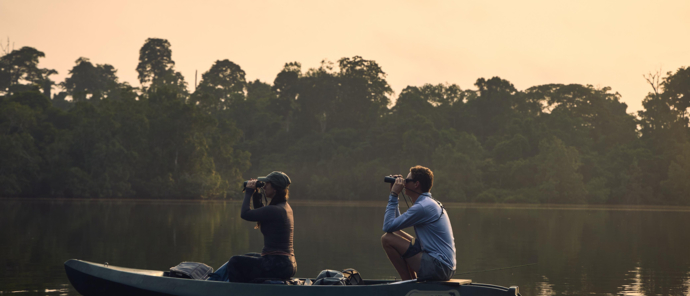
When we swap the boat motor for a kayak, the water’s surface echoes the forest’s sounds. Soon, we find a distant – but distinctly chatty – family of chimpanzees hanging out in the high branches. Floating in our kayaks, we take morning coffee in one hand and our binos in the other. After a few sedentary moments, we finally notice moustached guenons and putty-nosed monkeys spying on us through the leaves, the ever-present great blue turacos and black-casqued hornbills watching from higher up.
A few hours of paddling later, and we reunite with our boat – only to learn we’ve missed a passing western lowland gorilla by an hour – a lone silverback who'd come to the water to contemplate for a while. Too busy to stay, he’d sadly not awaited our return – or likely cared much about it. In this environment, encounters are fleeting – yet are all the more powerful for it. A moment of attention lapsed takes with it any evidence of what was just there.
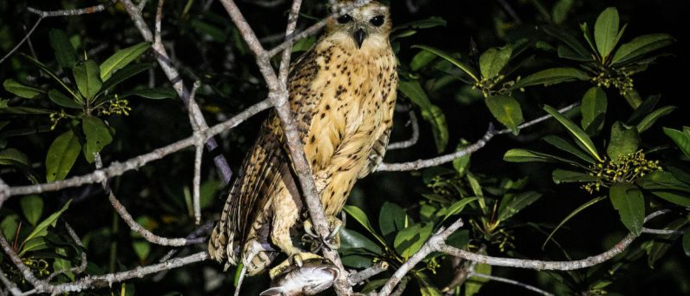
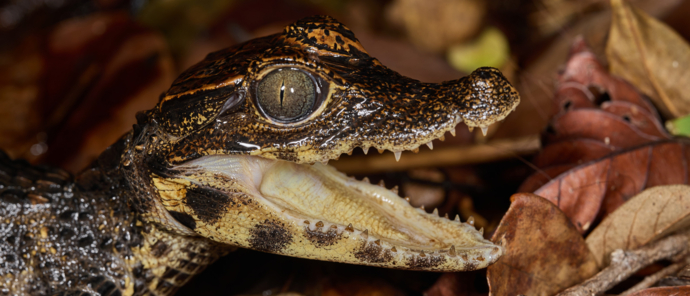
By night, the waterways’ residents swap shifts. Returning from a campfire on the beach, a Pel’s fishing owl stares down at us, a juvenile snapper stapled to its talons. Not much further on, and a dwarf crocodile’s reflective glare distracts us from amongst the mangroves.
A water chevrotain, the most charismatic of antelopes I’d never even thought I needed to meet, pops out against the leaf litter. A male leopard is later seen wandering just 50 metres from camp, in the same spot we come across a forest elephant bull who feels even more imposing by night – his thin but outstretched tusks on the verge of leaving their own tracks in the sand.
Of the three species of crocodile that call Sette Cama home, there are no anecdotes of any being a threat to humans. This is a story I refuse to accept, especially when paired with suggestions of relaxed afternoon dips in the lagoon. And, although we never see the West African manatees (except for a few double-takes after distant splashes) the lagoon is home to hundreds of them. Proof that there’s a lot more to discover here if only we take the time to pay proper attention.
Wildlife Monitoring
For all the wildlife that calls Gabon’s rainforest home, Sette Cama’s contrasting landscapes demand a slow approach. Where other wilderness areas come with a ‘blink, and you’ll miss it’ style caution, Sette Cama's landscape demands walking the same trail more than once, engaging every sense beyond just sight, and taking moments to be as still as possible so you don't distract from what’s really going on.
For every call you hear or flutter of wings you see, a physical map exists in footprints and burrowing marks, created by the residents who were there before you. Almost every forest clearing we crossed was stamped with different leopard tracks - the cats in question were typically absent. For all the fresh evidence found daily that Sette Cama hosts giant pangolin, the sightings themselves are few and far between, posing the question – what exactly is everyone up to – and when?
If we want tourism to have a purpose beyond each visit, building wildlife monitoring into our explorations is a perfect place to start. By setting up camera traps, returning to the same trails later in the week with newly trained skills for understanding the environment, downloading the findings and building out the data, we can explore Gabon’s diversity while adding to our understanding of it.
Of course, Sette Cama’s wilderness extends to the vast tracts of uninhabited coastline as well. Gabon itself hosts the largest population of nesting leatherback turtles globally, which are joined by olive ridley, green and hawksbill turtles coming ashore to lay their eggs.
Many sea turtle NGOs have already done the hard yards in Gabon. It’s up to us now to learn from their techniques, build out consistent data sets, and do what we can to improve nesting success on the stretch of coastline we can keep eyes on. From predation by monitor lizards to beached timber from the logging industry elsewhere that washes in on high tide, Loango's isolated beaches pose their own set of challenges for female turtles trying to nest. By conducting sea turtle patrols and monitoring our own turtle nursery, we have an opportunity to safeguard Sette Cama’s coastline while getting our own guests involved.
Sette Cama Eco Camp Opening
When we open Sette Cama Eco Camp in early 2026, we'll be offering the perfect fit for those who seek immersion over instant gratification. We’ll be creating the opportunity – and the space - to learn to speak the language of Sette Cama’s landscape and the residents who call it home.
As the first camp in our Machaba Wild offering, Sette Cama Eco Camp will redefine our approach to sustainable tourism. Machaba Wild and Sette Cama Eco Camp will not be built around a ‘typical day’ in the wilderness. In fact, we believe there should be no such thing.
Out here, the pace will be set by nature herself – shaping what we’ll do and when.
Our explorations will adapt to environmental shifts and how our guides see this changing the routine of wildlife, along with the clues they have left behind.
From April 2026, expect contrast over certainty: different landscapes to discover, varied ways of exploring them, and the chance encounters that bring the wild to life. We’ll be creating access without intrusion, using local knowledge to explore with intuition, and utilising tourism to monitor and preserve Loango National Park’s unique ecosystems.
Come with us as we open trails to watch them close behind us. Those who visit are invited to connect with truly wild spaces rather than being offered distractions from them in the form of private butlers and plunge pools. Through Machaba Wild and Sette Cama Eco Camp, we seek to build partnerships that protect not just the wild but also the communities that sustain it. We want you to learn to read the wilderness with us, instead of trying to tame it.
Come with us, as we create raw, immersive journeys that safeguard the wild – just as it is.
For more information, contact clare@machabasafaris.com